Tuesday Night, Three Points, One Shared Bag of Crisps: Inside Gateshead’s Board Game League
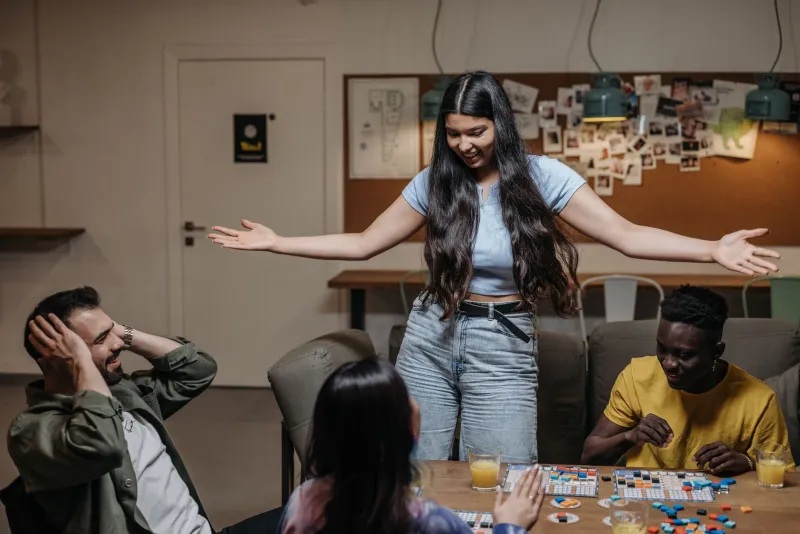
Tuesday night in Gateshead has a new rhythm. It is not the clatter of a controller or the hush of a cinema. It is the soft thump of a hundred cardboard tokens being tipped out, the rustle of a rules sheet being passed along, and the familiar plea of someone who has just realised they have misread a card: ‘Hang on — can I take that back?’
Welcome to the borough’s board game league: a weekly gathering that began as a handful of mates and a battered copy of Catan and has quietly become one of the most reliable fixtures on the local gaming calendar. It is competitive, but only in the way a Sunday five-a-side match is competitive. There are points. There is a table. There is also a shared bag of crisps and a fairly strict rule about not being a sore loser.
A league that looks like a living room
On paper, it is straightforward. Players turn up, get paired across tables, play a couple of games, and earn points depending on where they finish. A running scoreboard tracks the season. There are prizes at the end, though nobody seems entirely sure what they are until the final week.
In practice, the league looks less like a tournament and more like a very organised living room. Regulars arrive with tote bags full of games they hope to get to the table. Someone brings a flask. Someone else brings a box of those little supermarket doughnuts that vanish before the first round is over. A newcomer is greeted, handed a name sticker, and gently steered towards a table with a game that will not melt their brain in the first ten minutes.
‘The word league puts some people off,’ says one of the organisers, who has been involved since the early days. ‘They think it means chess clocks and silence. It really doesn’t. We wanted the structure of a league because it gives people a reason to come back, but we wanted the feel of a games night because that is the bit people actually enjoy.’
How Tuesday became a fixture
The league’s growth has been organic rather than advertised. It started with a message in a local group, moved through word of mouth, and now fills a room most weeks. There is no grand marketing plan. The main recruitment tool is still a regular telling a mate: ‘Come along, I’ll teach you the rules.’
That matters in a borough where gaming spaces can be scattered and where a lot of people are looking for something that sits somewhere between a night at the pub and a night in front of the telly. The league has become a third space for players who want company without committing to a full campaign, and for people who like the idea of competition but not the pressure of a formal club.
The Tuesday slot helps. It is early enough that people can come after work, late enough that the room has time to fill, and far enough from the weekend that it does not compete with family plans or nights out. Organisers say the mix is deliberate: experienced players, curious beginners, and a handful of people who mainly come for the chat and end up winning anyway.
The games doing the heavy lifting
The league does not stick to one game, which is part of its charm. A typical evening might see a table of Wingspan, another deep in Cascadia, and a third arguing cheerfully over Heat: Pedal to the Metal. Heavier euros appear when the mood takes hold — Brass: Birmingham has its devotees — but the league is careful not to turn every week into a three-hour brain workout.
‘We try to have a mix,’ says another regular. ‘If you turn up and every table is a heavy strategy game, you lose half the room. If every table is a party game, you lose the other half. The sweet spot is giving people a choice and making sure nobody is stuck watching.’
That approach has helped the league avoid the trap of becoming a closed shop. Games are chosen partly by player preference, partly by what fits the time, and partly by whatever someone has brought in a bag that week. There is a lending shelf for anyone who wants to try before they buy, and a standing offer for experienced players to teach rather than simply win.
Friendly rivalry, proper rules
Make no mistake: people want to win. There are quiet calculations over final scoring, good-natured groans when a plan collapses, and at least one ongoing rivalry over who is actually the best at trick-taking games. But the league has a clear culture. Rules are explained properly. Take-backs are allowed within reason. Gloating is tolerated only if it is funny.
That balance is harder to maintain than it sounds. Competitive board gaming can attract rulebook lawyers and silent optimisers, and a league can easily become a place where newcomers feel like they are intruding on someone else’s exam. Here, the organisers actively push against that. New players are paired with someone who will talk them through the first round. Experienced players are encouraged to spot when a table needs a hand.
‘The best compliment we get is when someone says they were nervous and then forgot to be,’ says one of the volunteers. ‘That is the whole point. You can take it seriously without taking yourself seriously.’
How to roll up and join
If you fancy giving it a go, you do not need a shelf of games, a rules degree or a team. The league is open to newcomers, and the easiest route in is to message the group’s socials or ask at the venue before the night. Turn up a little before the first round, say you are new, and let someone else do the matching.
Bringing a game is welcome but optional. Bringing a willingness to lose your first three games is useful. Bringing a snack to share is practically a shortcut to making friends. The league is not free — there is a small table fee to cover the room — but it is cheaper than most nights out in town and considerably more sociable than another evening scrolling through a backlog.
Why it matters more than the table
A board game league in Gateshead is not going to make national headlines. It does not need to. What it does is give people a regular place to be, a reason to talk to strangers, and a gentle structure that turns ‘I might pop along one week’ into a Tuesday habit.
In a gaming culture that often celebrates the solitary screen and the massive online lobby, there is something quietly radical about a room full of people agreeing to sit down together, learn a set of rules, and see what happens. The scoreboard matters. The shared crisps matter more.